
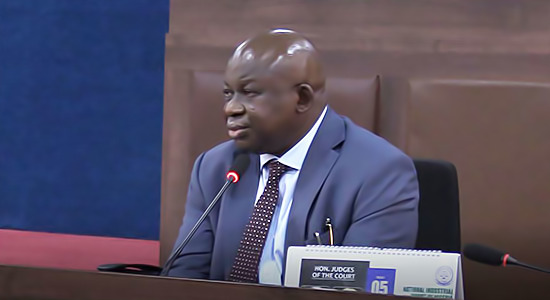
The President of the National Industrial Court, Justice Benedict Kanyip, has stated that no written law requires a senior military officer to retire simply because an officer junior to him has been appointed as a Service Chief. He made this known at a legal training seminar organised by the Nigerian Navy on the Strategic Enforcement of Maritime and Labour Law for Enhanced Naval Operations in Nigeria. He urged the Armed Forces of Nigeria to seek proper directions and interpretations on what he described as a “wasteful tradition” of prematurely retiring senior officers.
Justice Kanyip, who was represented by Justice Olufunke Anuwe, delivered a paper titled Labour Law and Military Service: Implications for the Armed Forces of Nigeria at the event held at the Headquarters Directorate of Legal Services (Army). Justice Anuwe explained that the issue should be examined in the context of the supremacy of the 1999 Constitution over the Armed Forces Act and other rules governing military service.
Justice Anuwe also addressed the recurring debate on an officer’s right to resign or retire voluntarily, affirming that individuals have the right to leave military service once proper notice has been given. She said the authorities cannot compel an officer to remain against their will, adding that resignation is lawful when carried out in accordance with the provisions of the Constitution.
Citing Section 217 of the 1999 Constitution, Justice Anuwestressed that military service must operate strictly within constitutional and statutory frameworks. She criticised situations in which officers are denied the right to resign, while senior officers who wish to continue serving are compulsorily retired following the appointment of new Service Chiefs, describing the practice as “the biggest irony within the military service.”
Justice Anuwe commended the National Assembly for its ongoing effort to review the Armed Forces Act and urged the armed forces to collaborate with the legislature to ensure the Act reflects current realities, international best practice, and the supremacy of the Constitution.
Speaking on the 15-year Voluntary Disengagement Rule, she noted that although it appears useful for maintaining discipline and protecting government investment in training, a deeper study shows that it undermines issues such as individual freedom, the limits of state authority, and the nature of military service in a democracy.
Justice Anuwe emphasised that the Armed Forces of Nigeria cannot be detached from the Nigerian state. She said the argument that military law jurisprudence is distinct from labourlaw jurisprudence, or that the Armed Forces Act stands apart from the Constitution, is “highly misconceived.” She added that reforms must balance personnel welfare with the need to maintain effective military discipline.